"Colorado" is the Spanish word for that particular reddish color of certain rocks and soil. This color is especially visible in areas where the earth is piled up, such as in the mountainous region of our western states. When the Spanish explorers first reached what is now the present state of Colorado they gave it the name that was most characteristic. It is still reflected today in the English names of towns like Redstone and Red Cliff that are scattered across the Rocky Mountains. It continues to be one of the most striking colors of the West.
I first started visiting Colorado a number of years ago, but it wasn't until my recent association with the Vail International Gallery that I began to seriously consider doing a series of landscape paintings in the area. This past summer I arrived with a portable painting box and a number of blank canvases with the intention of doing some plein air scenes.
Plein air, or painting out of doors, has been around Colorado for a long time, as it has been elsewhere. It was the French Impressionists who fully developed the idea, and it has been adapted to almost every region on Earth. In early July I managed to meet up with some Colorado plein air painters for a group painting excursion.
I quickly noticed that there were several differences between the eastern plein air painters and their western counterparts. For painters back East there is the potent example of the Hudson River School of painting, which stressed form and perspective. And there was also the school of Luminist painters who brought Light as the prominent element of landscape painting. So an eastern painter is mainly concerned with light, form and perspective.
By contrast the western painters were all about color and pattern. I could see this from their very first brushstrokes. Perhaps this is due to the influence of indigenous painting, that is to say American Indian art, or it might just be the natural response to the striking features of the landscape. In any case, Western painting can be distinguished by its strong, pure colors. I realized that I would have to alter my palette, but by how much? Actually, in the end it was the clarity of the air and strong patterns of light and shadow that guided me, and I felt very comfortable adapting my technique to paint these new scenes.
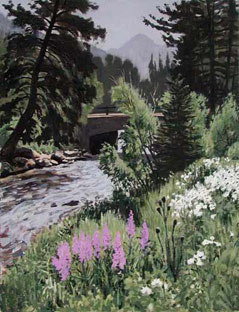
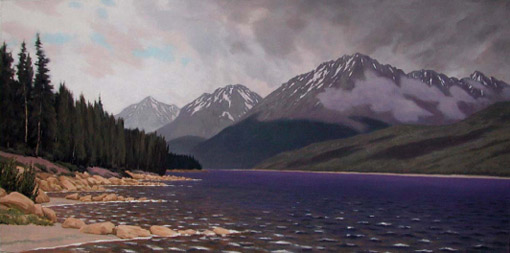
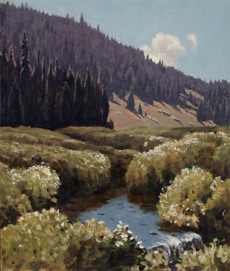
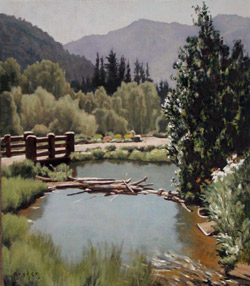
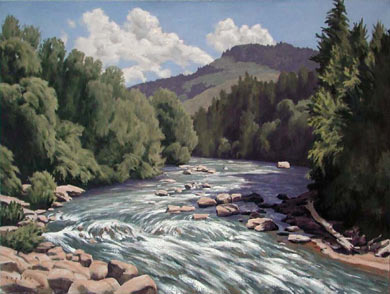
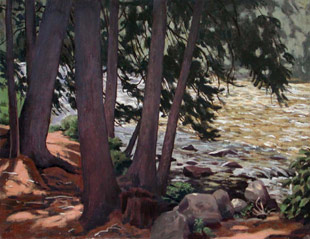
I have always been fascinated by water in painting, so I began to seek out places where I could paint that would show something of this element. In the mountains that means either a rushing stream or a quiet lake at the bottom of a valley. One of my first compositions was of the reflecting pond in the Betty Ford Park at Vail. It is called "High Oasis," the name used to describe the plants that are growing around the pond. This is similar to "Moon Peak," which shows a pond made by a beaver dam. Another early painting was "A Quiet Place" along Gore Creek, also in Vail. The water rushing over rocks was a particular challenge. Eventually I got to paint the more ambitious "Eagle River," which combined both the white water and the distant mountains in light. There were other water scenes to paint, however. The little mountain stream in "Back of the Mountain" is one. "Wildflowers by the Bridge" is another such view, this one also of Gore Creek.
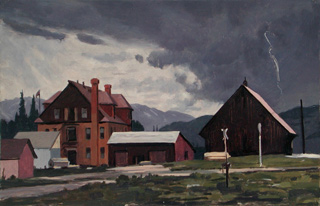
My visit to Leadville was particularly revealing. The very clear light evident here made everything seem so close, and the high altitude meant that dramatic weather effects were right on top of you. I did the painting "Mt. Massive from Leadville" in a morning light that seemed almost painfully clear and sharp. The picture "The Old Hospital" is of one of Leadville's famous landmarks seen in the dramatic light of an afternoon storm. "Lake Turquoise After a Storm" tries to capture that quality of light which comes after a brief summer shower.
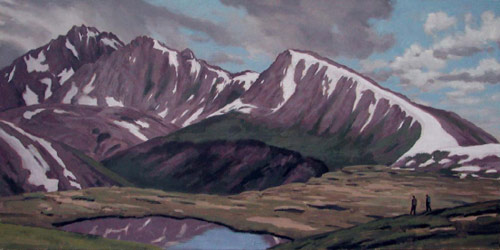
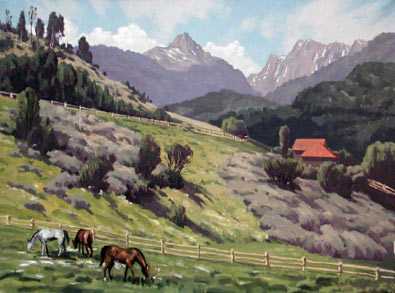
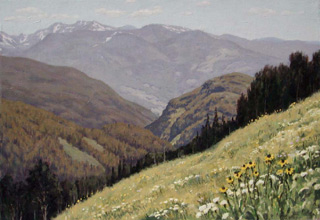
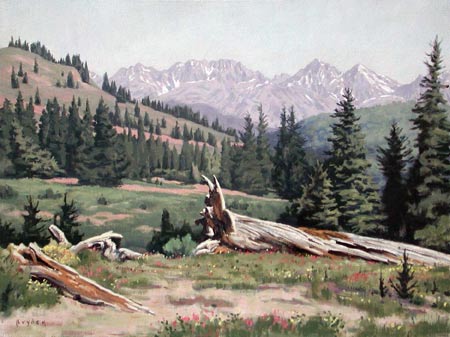
When I was at the higher elevations I also got a chance to try my hand at painting the mountain peaks. Both "Shrine Pass" and "Independence Pass" were an attempt to show the color and light at the highest altitudes. "East of Aspen" was done nearby on the road to Aspen. "Colorado Horse Country" was also concerned with the high altitudes, only here where horses and people lived. The painting "Game Creek Vista" is from the ski slopes of Vail seen in the height of summer.
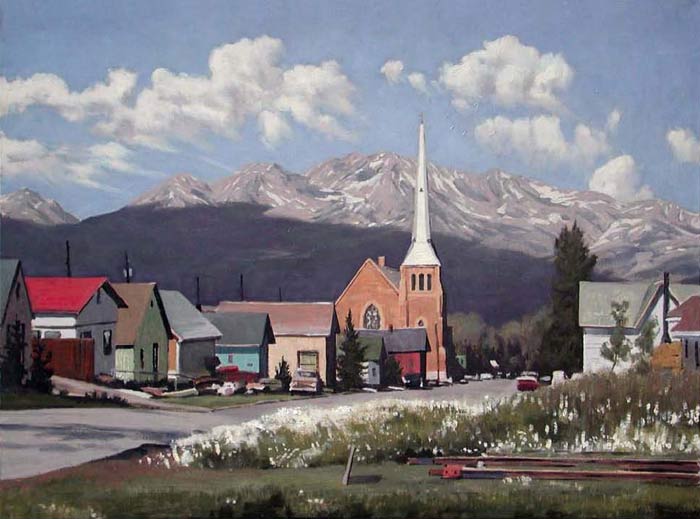
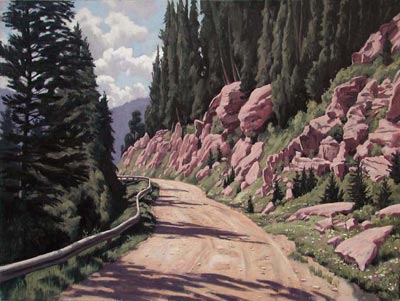
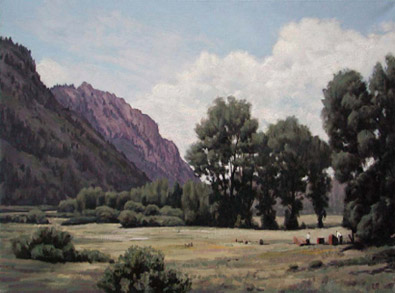
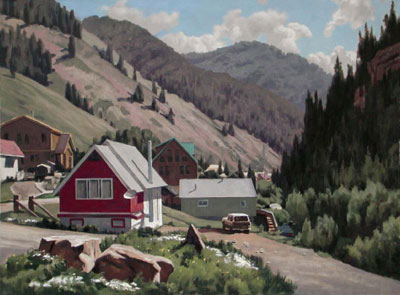
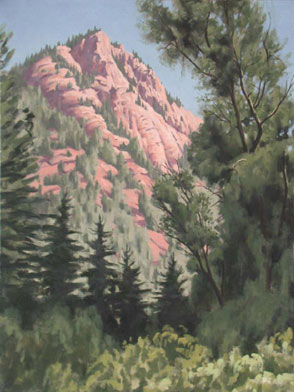
The two towns I mentioned earlier, Redstone and Red Cliff, were both the inspiration for paintings. "Redstone," the painting, is solely concerned with that color for which Colorado is named. Red Cliff is seen in the painting "Small Mining Town." To me the latter epitomizes what the West must have been like in the past. Today the town of Red Cliff is rapidly changing, but still retains the flavor of its romantic past. On the way to Red Cliff is the mountain road shown in "Lime Creek Road."
—Lewis Bryden
In all there were seventeen paintings at the Vail International Gallery, 100 East Meadow Drive #17, in Vail, Colorado.
|